Alpha Centauri A
HD 128620 · α Cen A · Nearest stellar neighbor · 1.34 pc · G2V
Section 01
General Information
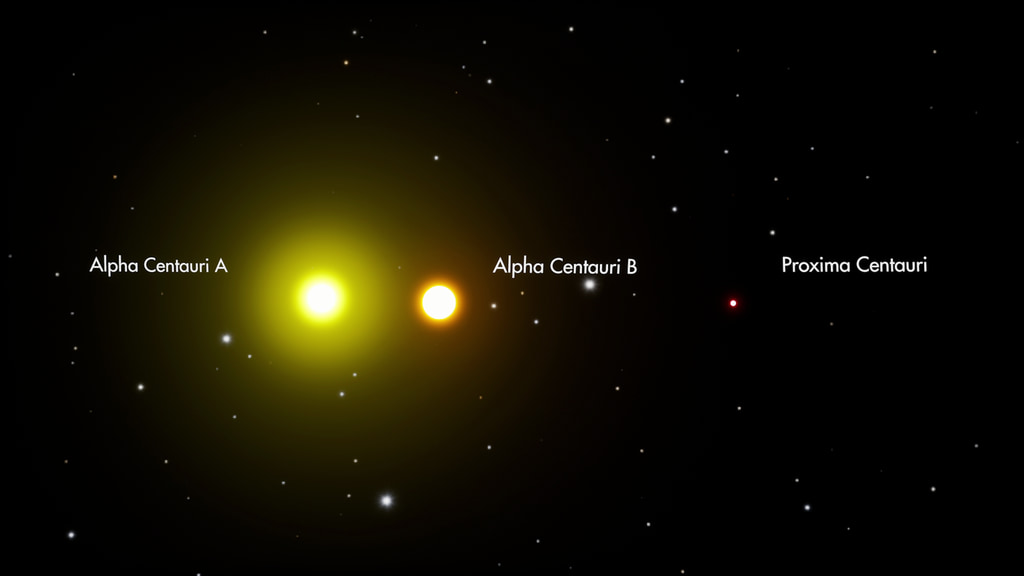
Alpha Cen A is almost a solar twin — G2V, [Fe/H] ≈ +0.20, age ~5 Gyr. Its proximity (1.34 pc) gives HARPS the highest possible SNR of any FGK target, making it an ideal calibration check against the Sun. The JWST MIRI planet candidate (2-year orbit, ~Saturn mass) adds a compelling reason to complete the abundance analysis urgently.
Stellar Parameters
| Parameter | Symbol | Value | Source |
|---|---|---|---|
| Effective temperature | Teff | ~5790 K | Literature consensus |
| Surface gravity | log g | ~4.31 | Literature consensus |
| Metallicity | [Fe/H] | ~+0.20 dex | Literature consensus |
| Mass | M★ | ~1.10 M☉ | Literature consensus |
| Spectral type | — | G2V | Nearly solar twin |
| Distance | d | 1.34 pc (4.37 ly) | Hipparcos / Gaia |
Known Planets
| Planet | Mass | Type | Semi-major axis | Hab zone |
|---|---|---|---|---|
| Candidate (MIRI) | ~Saturn-mass | Gas giant candidate | ~2 AU | TBD — unconfirmed |
Section 02
NASA Interactive Visualization
Section 04
Our Findings
Section 05
References & Credits
Key Literature
Pourbaix et al. (2016) — Alpha Cen binary orbit
Thévenin et al. (2002) — stellar parameters
JWST MIRI coronagraph detection (in preparation)
de Mooij et al. (2023) — candidate planet detection
Data Sources
NASA/IPAC Exoplanet Archive
SIMBAD / CDS — stellar parameters
Hipparcos / Gaia — parallax & distance
Image Credits
Credit: ESA/Hubble — Alpha Centauri A and B binary system
Interactive sky: CDS Aladin Lite v3 / DSS2
NASA Eyes: NASA/JPL-Caltech
Pipeline
HARPS S1D — ESO Science Archive
Analysis: The Exoplanet Codex