51 Pegasi
51 Peg · HD 217014 · 15.6 pc · G2IV · Birthplace of exoplanet science
Section 01
General Information
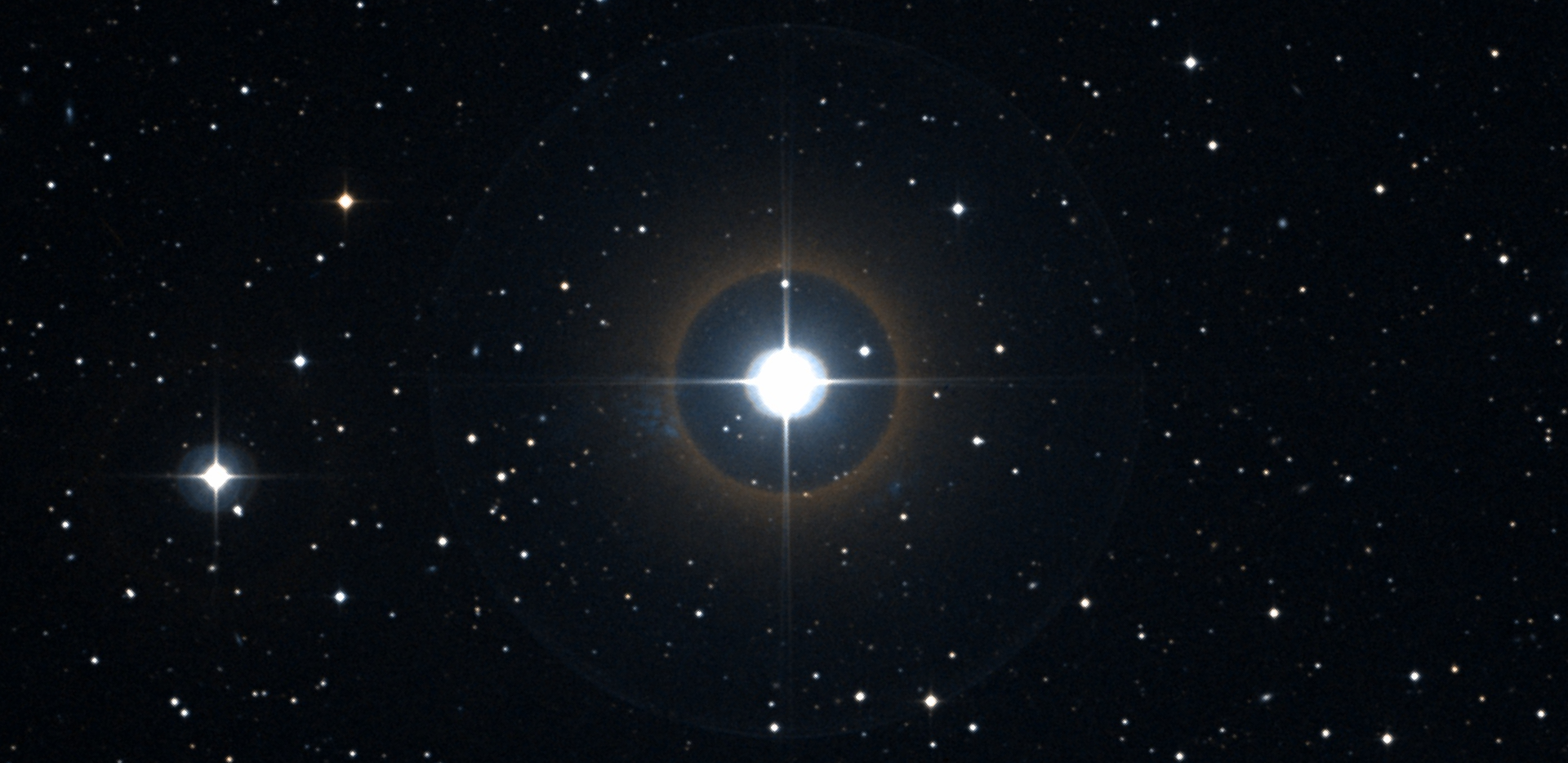
On 6 October 1995, Mayor & Queloz announced the first confirmed exoplanet around a Sun-like star. Dimidium (51 Peg b) — a half-Jupiter-mass planet orbiting in 4.23 days — was so surprising that most astronomers initially refused to believe it. The Nobel Prize in Physics 2019 recognised this discovery. Its host star is a slightly evolved solar twin with [Fe/H] = +0.20 — similar to Alpha Cen A.
Stellar Parameters
| Parameter | Symbol | Value | Source |
|---|---|---|---|
| Effective temperature | Teff | ~5793 K | Literature |
| Surface gravity | log g | ~4.33 | Literature |
| Metallicity | [Fe/H] | ~+0.20 dex | Literature |
| Spectral type | — | G2IV | Slightly evolved solar twin |
| Distance | d | 15.6 pc (50.9 ly) | Gaia DR3 |
Known Planets
| Planet | Mass | Type | Semi-major axis | Hab zone |
|---|---|---|---|---|
| Dimidium (b) | 0.47 MJ | Hot Jupiter — prototype | 0.0527 AU | No — tidally locked |
Section 02
NASA Interactive Visualization
Section 04
Our Findings
Section 05
References & Credits
Key Literature
Mayor & Queloz (1995), Nature 378, 355 — discovery (Nobel 2019)
Butler et al. (1997) — confirmation at Lick
NASA Exoplanet Archive — Dimidium parameters
Data Sources
NASA/IPAC Exoplanet Archive
SIMBAD / CDS — stellar parameters
Hipparcos / Gaia — parallax & distance
Image Credits
Image: ESA Sky / DSS2 — 51 Pegasi field
Interactive sky: CDS Aladin Lite v3 / DSS2
NASA Eyes: NASA/JPL-Caltech
Pipeline
HARPS S1D — ESO Science Archive
Analysis: The Exoplanet Codex